



Note: This new course is coming soon and is currently available for pre-order.
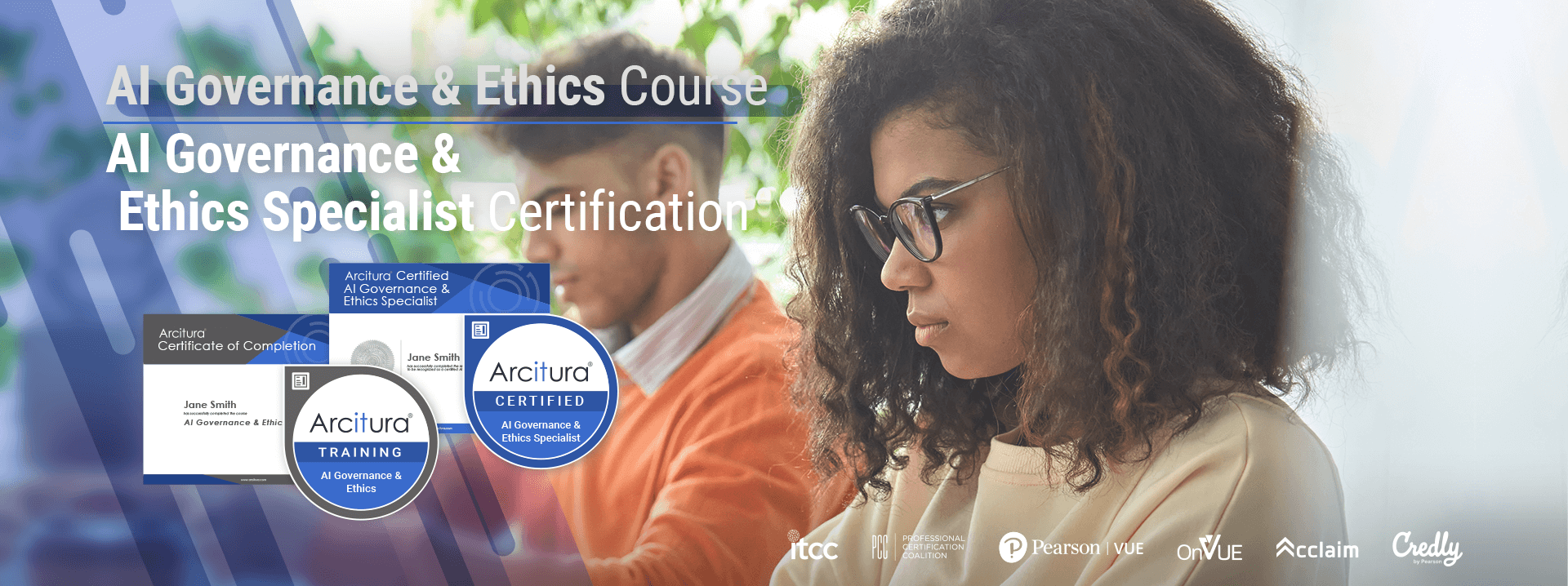
The AI Governance & Ethics course establishes the foundations of AI governance with precepts, processes and roles that address the on-going governance of AI systems. The governance of training and production data is covered, along with controls and considerations associated with ethical practice, model explainability and regulatory compliance. This course further extends AI governance practices and considerations in cloud-based environments.
Complete the AI Governance & Ethics course and, optionally, get accredited as a Certified AI Governance & Ethics Specialist by passing the certification exam. You can purchase the course now and get the exam later, or you can get them together at a discount as part of the Certification Bundle.
Upon completing the course you will receive a digital certificate of completion, as well as a digital training badge from Acclaim/Credly. Because this course encompasses both the AI Professional and AI Governance & Ethics Specialist certifications, upon passing the exam you will also receive official AI Professional and AI Governance & Ethics Specialist digital accreditation certificates and certification badges from Acclaim/Credly, along with an account that can be used to verify your certification status.
If you already completed the AI Professional course modules, you can purchase a partial course (or a partial bundle) with only the modules specific to the AI Governance & Ethics Specialist track here.

Choose the Certification Bundle to receive the entire course together with the online-proctored certification exam and a set of practice exam questions, all at a bundle discount.
Exam Details
Exam Details
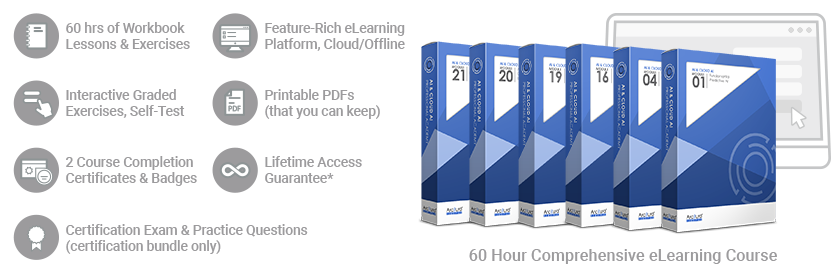
Upon purchasing this course, you will automatically receive access via the Online Interactive eLearning platform. To provide you with the greatest flexibility, you will also have the option to access the course materials via two additional eLearning formats, at no extra cost. All three eLearning formats are briefly described below. A more detailed comparison can be found here.
- For everyday learning: An online interactive eLearning platform with individual lessons, as well as interactive and automatically graded exercises and practice questions.
- For learning on-the-go: A study kit platform with access to full course documents that support online/offline synching, annotations, comments, custom bookmarks and cross-document searches.
- For your reference: A set of printable watermarked PDF documents that you can keep (for all course workbooks and posters).
All three forms of access are subject to Arcitura’s *.
Upon purchase, access to the online interactive eLearning platform (1) is provided within one business day. Access to the study kits (2) and the PDF documents (3) is provided upon request.
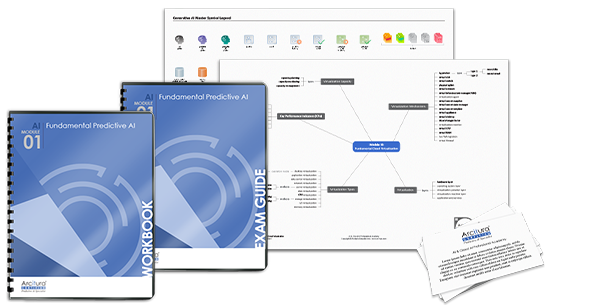
The course is comprised of a set of modules. Each module has a set of lessons and is further supplemented with exercises to help reinforce your understanding of key topics. Shown below are the digital contents and the topic outline for each course module:
Module 1: Fundamental Predictive AI
This course module illustrates how predictive AI can be used and applied in a range of business applications, as well as essential coverage of predictive AI practices and systems. The module explores the most common learning approaches and functional areas that AI systems are used for. All of the content is authored in easy-to-understand, plain English.
Course Module Contents
Topics Covered
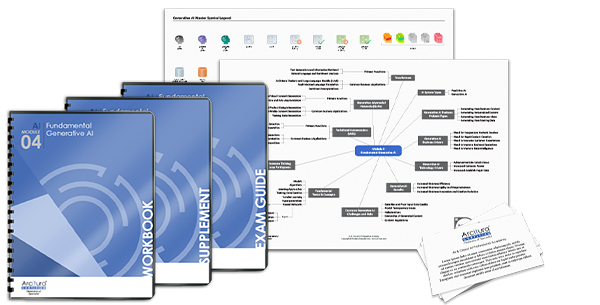
Module 4: Fundamental Generative AI
This course module explores the application of generative AI within a range of business scenarios and provides fundamental coverage of generative AI concepts, models, best practices and neural networks, including Generative Adversarial Networks (GANs), Variational Encoders (VAEs) and Transformer models. All of the content is authored in easy-to-understand, plain English.
Course Module Contents
Topics Covered
Module 16: Fundamental Agentic AI
This course module establishes the fundamental concepts, building blocks and capabilities of intelligent AI agents that can perceive, reason and act autonomously. Key components of multi-agent agentic AI systems are covered, including the use of large language models (LLMs), environmental models, knowledge graphs, and system prompts. Common benefits and challenges of using agentic AI are described, along with a preliminary exploration of using agents alongside humans in workplace environments.

Course Module Contents
Topics Covered
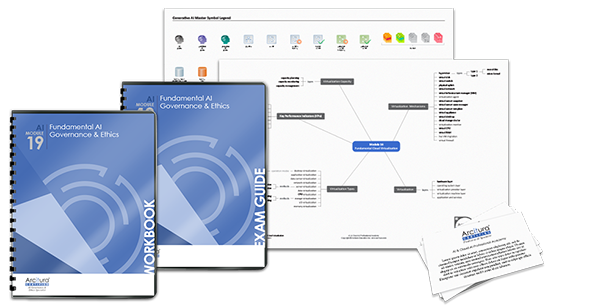
Module 19: Fundamental AI Governance & Ethics
This course module introduces the essential components of AI governance and explores the ethical considerations surrounding autonomous and agentic AI systems. Topics include fairness, transparency, privacy, and accountability, as well as risks of goal misalignment and bias. A vanilla governance framework is introduced, covering precepts for training data, production data, and cloud-based AI, in addition to embedding ethical practices and autonomy oversight into AI system designs.
Course Module Contents
Topics Covered
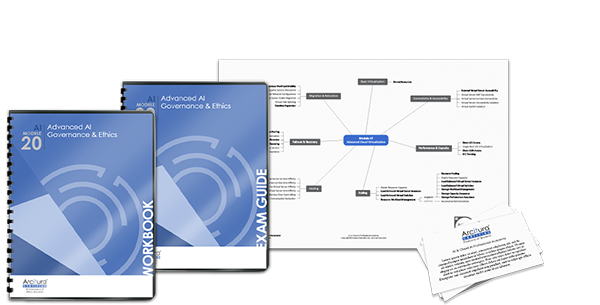
Module 20: Advanced AI Governance & Ethics
This course module delves deeper into governance frameworks, introducing roles for bias mitigation, explainability, and agentic oversight. Additional topics addressed include aligning AI with social values, regulatory requirements, and governing autonomous tool-use. Advanced methods for monitoring behavioral drift, human-on-the-loop intervention, and data management are addressed, alongside cloud-related policies for privacy, regional data storage, and other common data-related policies.
Course Module Contents
Topics Covered
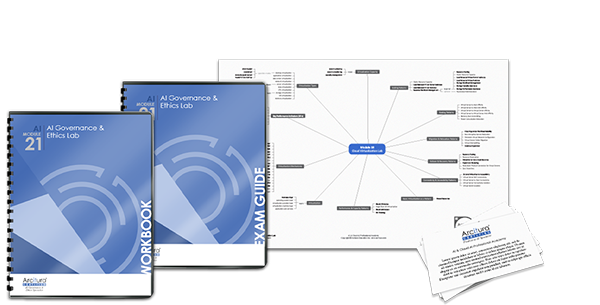
Module 21: AI Governance & Ethics Lab
This course module provides a series of case-study driven, lab-style exercises and problems that are designed to test your ability to apply your knowledge of topics covered in previous modules. Completing this lab helps reinforce understanding of preceding topics and further demonstrates how different practices and technologies can be applied together as part of greater solutions.
Course Module Contents

Learn About Arcitura: Take the Video Tour
Watch these helpful informational videos to learn about Arcitura programs, courses and certifications.
About Arcitura
About Arcitura Courses
About Arcitura Certifications
What’s in an Arcitura Course

Comprehensive
Coverage
Each course provides a comprehensive curriculum with 2-3 modules and 20-40 hours of training.

More Than Just
Video Lessons
In addition to standard video lessons, courses include full-color workbooks and reference posters for all
lessons.

Interactive & Graded
Challenges
Courses also include interactive and graded exercises, interactive and graded self-tests and other
supplements.

The Arcitura Difference

EACH COURSE
- is authored by a dedicated courseware development team
- has a self-test, accreditation exam and professional certification
- is available via two different eLearning platforms
ALL COURSES
- undergo a common development process
- are authored to be consistent in quality, structure and style
- share a common vocabulary and symbol notation
- are authored in collaboration with subject matter experts
Take Your Skills Anywhere
Because both courses and accreditations are vendor-neutral, they empower you with skills and credentials that you can take to wherever you need to go.

Lifetime Access Guarantee
Access to the eLearning platforms is dependent on third-party platform providers. As a result, Arcitura cannot make any guarantees or warranties regarding the behavior or availability of the platforms, nor can Arcitura guarantee a specific duration for which these platforms will remain available. When your course is set up on an eLearning platform, your access will have no expiration date and will be provided indefinitely. The PDF documents that can be made available for you to download are yours to keep forever.

